
30 Days of Love 2026
Week One: Reimagining Thriving
Reflection
by Rachel Myslivy, UUA Climate Justice Strategist
When we ask ourselves to “Reimagine Thriving”, what does that mean? Why reimagine? Can’t we just imagine and get on with it?
Here’s why it’s important to reimagine: most of us already imagine thriving, and that usually means imagining what it means for me and people like me to thrive: for people of privilege, that means imagining thriving for people of privilege; white people for white people, Americans for Americans, global majority for global majority, and so forth.
The invitation to reimagine asks us to pause. In that sacred pause, we have the space to reflect on what it means for all communities to thrive. In that wondering, we can reorient ourselves away from individual goals and towards collective liberation. We can shift our ideas of the future to center love.
I’m going to be honest: for people who work on climate, this is hard. We know that even if we did everything right starting now, climate disruption will challenge our communities far into the future. We know that the best-case scenario is increasingly out of reach as our government is repealing the policies that keep our communities safe, opening wildlife refuges to drilling, permitting logging in pristine ecosystems, and sabotaging climate goals so corporations can line their pockets at our expense. The path to a flourishing future goes farther and farther off the map as our country rapidly accelerates in the wrong direction. We know how bad things will get, and we stuff our grief and anger and anxiety deep into our pockets and forge on. When your best hope for the future is clouded by the belching smoke of coal stacks and drenched in flood waters, it’s hard to imagine anything but doom. It’s hard. When hope is hobbled by fear and tethered to despair, we must reimagine. We must reimagine. We must reimagine.
The ability to reimagine is a superpower. It keeps us from prioritizing short-term gains and being misled by false solutions that derail our focus and distract us from long-term goals. Reimagining keeps us from prioritizing technical solutions that are out of reach for most people, from carbon tunnel-vision when we need big picture thinking, from sacrificing justice for expediency. It helps us find that unshakable true North that will always call us back to ourselves.
Reimagining asks us to realign, reconnect, to re-everything so we can dream beyond our current limitations into a place of connection and possibility. It helps us hold a mindset where hope and joy are not distractions from the work but are, in fact, how the work becomes a joy guided by hope, aligned with our most deeply held values. It’s how we drop our armor and shine forth what we know is good and true. And then, dancing in our souls, we can recalibrate ourselves to that joyful, faith-filled path over and over again.
Reimagining asks us to imagine differently than we imagined yesterday, to imagine in all directions, unfettered, unhindered, unbound. As people of faith, we are forever called to reimagine, to center love and to let it guide our way, to believe that a better world is not only possible, but that we are creating it right now, every day, in large and small ways. We can reimagine a flourishing future and hold it in our hearts, not restricted but reinforced, not for what I think can be done in my lifetime but what will live on beyond me. We have everything we need, in community, in faith, to realize a future where all communities flourish. Let’s reimagine together, beloveds, a world with love at the center.
Creative Practice
“Reimagining Thriving” Coloring Sheet by Lena Kassicieh
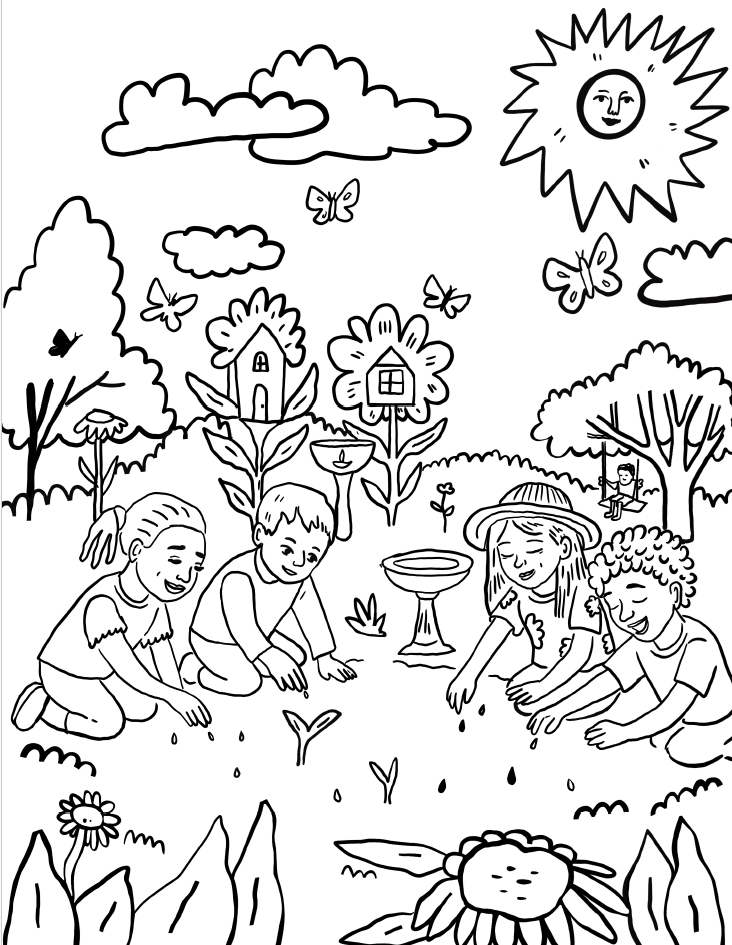
Image description: A black and white handdrawn illustration of children gardening with whimsical elements like flowers that are also houses, chalices, butterflies, and a smiling sun.
Body Practice
Inspired by "The Work of Creation" by Israel Buffardi
Multigenerational Activity
Something to sing together as a family
UU Hymnal, Singing the Living Tradition: #6, “Just as Long as I Have Breath”
“Kindness” by The Juicebox Jukebox
Something to watch together as a family with younger kids
Reflection: Which of your friendships feel like good relationships, and how do those relationships help us?
Something to watch together as a family with older kids
Reflection questions:
What does the thread represent to you?
What feelings come up as you listen to this poem?
Have you ever tried dancing like this, where you move your body to reflect how a poem or song feels?
Something to do together as a family
Practicing gratitude is a way to help us nurture hope and continue a lifelong practice of social justice action. It helps strengthen the foundation that inspires us to act on our values. Try one of the following practices together or come up with one that can work for you on a long-term basis. Be explicit with kids that practicing gratitude has been shown to benefit physical, emotional, and mental health.
Mealtime gratitude: Take turns, having each person share what they are feeling thankful for as you eat.
Gratitude journal: Start or end each day with writing down one or more appreciations. The act of writing (or drawing) appreciations helps embody the feelings.
Gratitude chain: Cut strips of paper, leave them in a basket. Each day, each person writes something they are grateful for on a strip of paper and adds it to the chain. Do this for every day of 30 Days of Love!
Theological Conversation
In this opening conversation, Side With Love’s Rev. Brandan Robertson speaks with Dr. Elías Ortega about reimagining thriving through the lens of Unitarian Universalist theological education. Drawing on his work as a scholar, educator, and denominational leader, Ortega reflects on how joy, justice, and theological formation equip leaders to respond to a complex world demanding religious literacy, intercultural competency, and adaptive leadership.
Dr. Elías Ortega is an interdisciplinary scholar and serves as President of Meadville Lombard Theological School, the Unitarian Universalist seminary. He holds an M.Div. and Ph.D. in Religion and Society from Princeton Theological Seminary and a B.A. from Calvin College. Prior to joining Meadville Lombard, he was Associate Professor of Social Theory and Religious Ethics at Drew University Theological School, where he also served in multiple governance and advisory roles. His teaching and research span sociology of religion, religious ethics, social movements, critical theory, Africana Studies, and Latinx Cultural Studies.
Dr. Ortega has taught at institutions including Princeton University, Vanderbilt Divinity School, and Princeton Theological Seminary, and has provided extensive service to the Unitarian Universalist Association, including serving on the Commission on Institutional Change and the Religious Education Credentialing Committee. His denominational and community work reflects a deep commitment to justice, equity, and compassion as central to religious leadership.
Reflection Practice
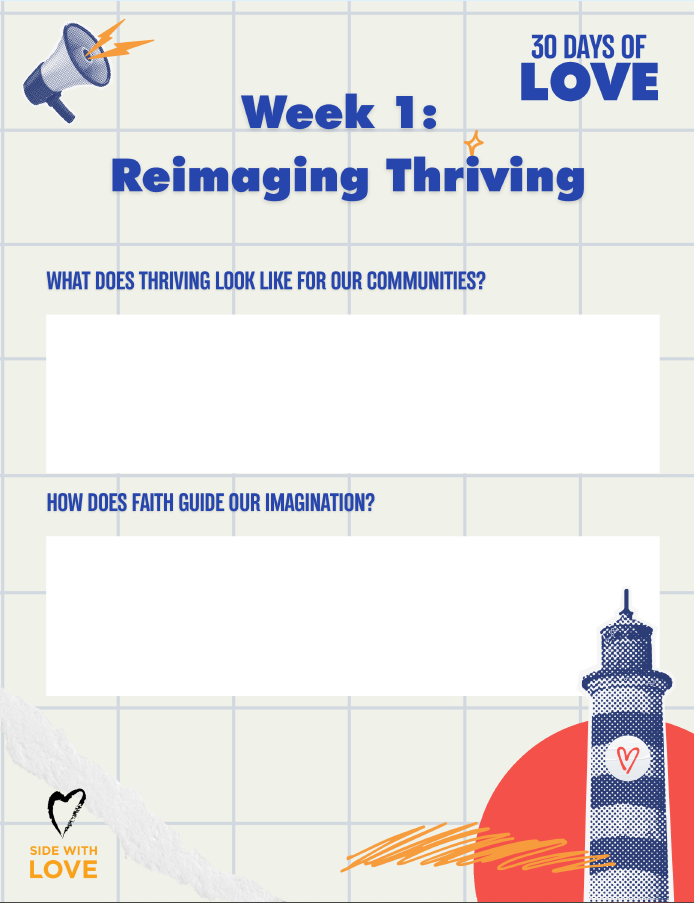
Image description: a screenshot of the journaling page that reads "30 Days of Love, Week 1: Reimagining Thriving". The background is a faint gridded pattern, with a blue and gray megaphone with yellow lighting in the upper righthand corner. Two text boxes are in the center of the page, one for each of the following questions: What does thriving look like for our communities? How does faith guide our imagination? The bottom lefthand of the document has a blue and grey striped lighthouse against a red circle and yellow squiggle with the Side With Love logo across from it.